
Investing in a startup or entering into a business relationship with a founder involves more than evaluating a business plan. Investors, corporate partners, financial institutions and other stakeholders also need to understand the background of the individuals who control or influence the proposed venture.
Startup founder due diligence helps clients identify relevant integrity risks, examine business affiliations and understand whether a founder has connections that could expose the proposed relationship to financial, regulatory, reputational or other risks.
However, conducting due diligence on a startup founder presents a challenge. What happens when the founder is a college student? How should an investor assess someone who has never held a formal job? What if the startup has no revenue, and its founder has never established another business?
A lack of employment history does not automatically prevent startup founder due diligence. The essential requirement is sufficient identifying information to establish which individual is being assessed. Without a unique identifier that enables the subject to be distinguished from other people with similar names, Riskpro cannot initiate the assignment.
Riskpro Management Consulting provides investigative due diligence and business intelligence services in India. Its due diligence capabilities include examining the backgrounds of business promoters and identifying relationships that may be relevant to risk assessment. Riskpro has also developed proprietary intelligence tools, including DiligenceX, to help identify relationships between individuals and entities, including connections with heightened-risk individuals and businesses.
Riskpro’s due diligence services
This guide explains what clients should prepare before requesting startup founder due diligence, how first-time entrepreneurs can be assessed and why understanding a founder’s business relationships may be important to an investment or commercial decision.
1. What Is Startup Founder Due Diligence?
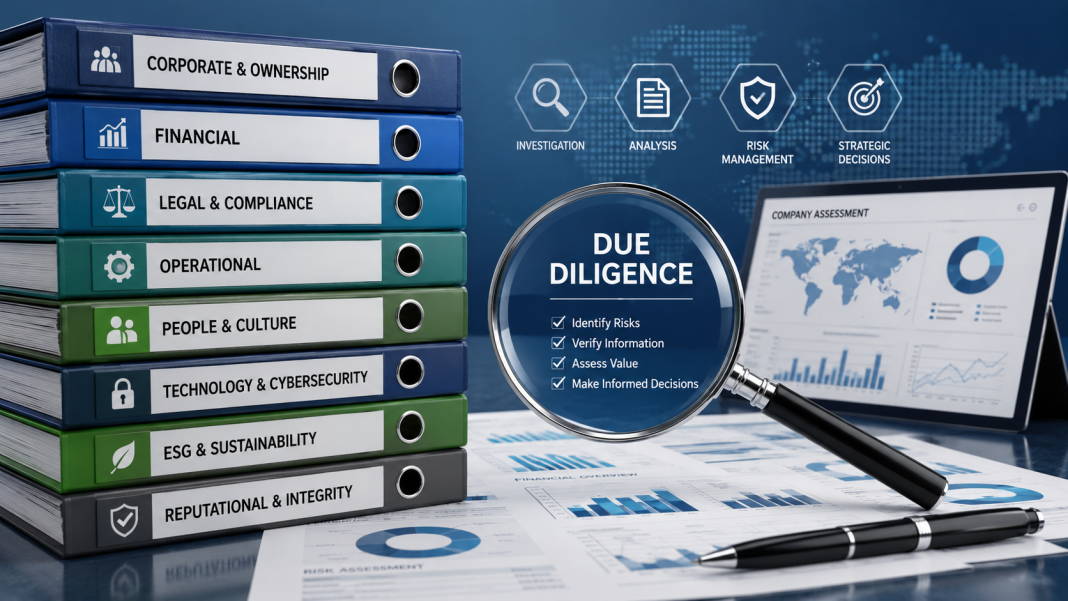
Startup founder due diligence is an investigative assessment of an entrepreneur’s background and relevant business relationships before an investor or another organisation enters into a commercial relationship with the individual or the startup.
The purpose is to identify information that may not be apparent from a pitch deck, company registration certificate, website or initial meeting.
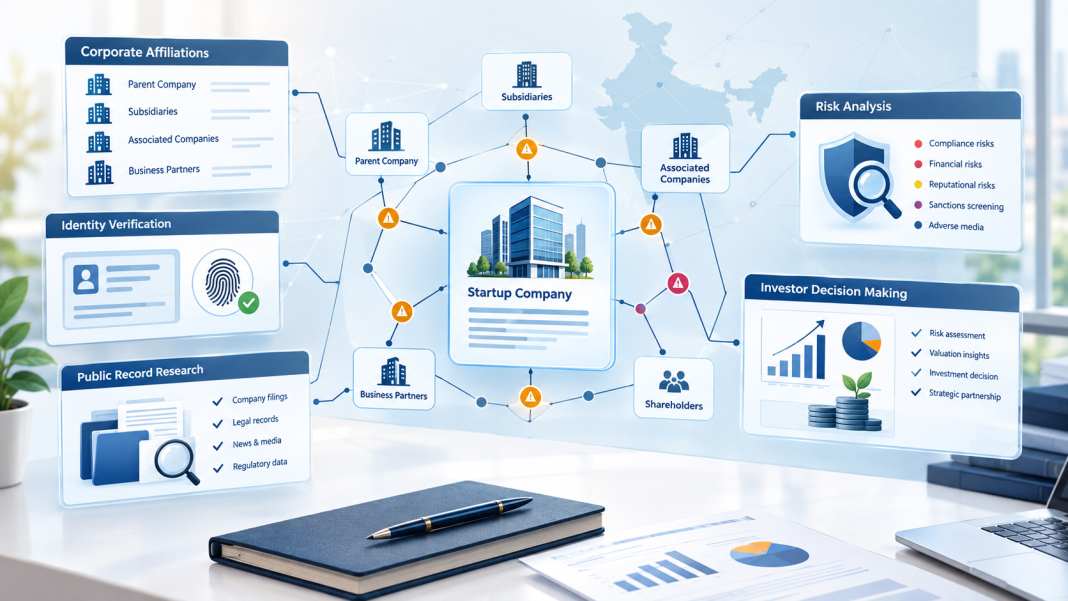
Depending on the agreed scope, founder due diligence may examine:
- Identity and identification details: Establishing the correct individual as the subject of the investigation.
- Business affiliations: Identifying relevant associations with companies, directors, shareholders and other business entities.
- Connections with heightened-risk individuals: Examining relevant relationships that may create financial, political, regulatory or reputational exposure.
- Public-record information: Reviewing relevant corporate, litigation, regulatory and other accessible records within the agreed scope.
- Reputational risk: Assessing relevant information from credible public sources.
- Potential conflicts of interest: Identifying business relationships that may be material to the proposed investment or commercial arrangement.
The exact scope depends on the client’s requirements and the nature of the proposed relationship.
Startup founder due diligence should not be confused with a complete financial, legal, technical or commercial assessment of the startup. These are distinct workstreams that may be required alongside an investigation of the founder.
2. What Documents Are Required to Initiate Founder Due Diligence?
Before commissioning a founder background investigation, the client should assemble enough information to identify the subject accurately and explain the purpose of the review.
The most important requirement is a unique identifier for the individual. A name alone may not reliably distinguish a founder from other people with the same or similar names.
Essential information checklist
| Information or document | Why it matters |
|---|---|
| Full legal name | Establishes the name under which the individual is being assessed. |
| Unique identifier | Enables the individual to be distinguished from others with similar names. This is a prerequisite for Riskpro to initiate the assignment. |
| Date of birth or other corroborating details, where available and appropriate | Helps resolve potential identity ambiguity. |
| Current company or startup name, if applicable | Establishes the business context of the assignment. |
| Company registration details, if incorporated | Helps identify the relevant legal entity and its corporate associations. |
| Founder’s role in the startup | Clarifies whether the individual is a founder, promoter, director, shareholder or another relevant party. |
| Purpose of the due diligence | Helps establish which risk areas are material to the client’s decision. |
| Relevant known business affiliations | Provides useful context for assessing corporate relationships and potential connections. |
The precise documents required will depend on the engagement. Clients should confirm with Riskpro which unique identifiers and supporting information are acceptable for their particular assignment.
A passport, PAN or another government-issued identifier may be relevant, depending on the subject, jurisdiction and agreed requirements. Clients should not assume that every identifier is interchangeable or that any one document will automatically satisfy Riskpro’s requirements.
Can Riskpro begin due diligence using only a founder’s name and LinkedIn profile? A name and online profile may provide context, but they do not replace the required unique identifier. Riskpro will not initiate the work if the necessary unique identifier is unavailable.
This requirement helps reduce the risk of confusing one individual with another and attributing a business relationship, adverse report or other finding to the wrong person.
Clients should transmit identification documents through an appropriate secure channel and provide personal information only to the extent necessary for the engagement.
3. Can Investors Conduct Due Diligence on a Student Founder?
Yes. A founder’s student status does not, by itself, prevent a due diligence assessment.
Student entrepreneurs may be developing a product, building a technology platform, participating in an incubator or establishing their first company. They may have no previous employer, no established business history and no significant financial track record.
These circumstances are common among early-stage entrepreneurs. They should not automatically be interpreted as adverse risk indicators.
When assessing a student founder, the client should focus on the purpose of the investigation and the risks relevant to the proposed relationship.
For example, an investor considering a substantial equity investment may want to understand the founder’s relevant business affiliations and whether any material risk connections exist. A corporate partner evaluating a proposed strategic relationship may have similar concerns.
The absence of an employment record does not answer these questions. Nor does it establish whether the founder has connections that could affect the proposed relationship.
Riskpro’s investigative due diligence offering is relevant to these broader questions because it focuses on the background of promoters and the business relationships that may influence risk. Its proprietary intelligence capabilities can help clients examine relationships that are not necessarily apparent from a conventional résumé or company profile.
Clients should therefore distinguish between a founder’s limited professional experience and the separate question of whether the individual presents a material integrity or relationship risk.
4. How Should Clients Assess Founders With No Employment History?
Employment history is only one possible source of background information. A person who has never worked for an employer may still have business affiliations, company directorships, ownership interests or other relationships relevant to an investigation.
For example, consider a graduate who establishes a technology startup immediately after completing college. The individual has never held a formal job and cannot provide appointment letters, salary slips or relieving documents.
Those employment records are not applicable to the individual’s circumstances. Their absence does not establish misconduct.
The investor’s concern may instead be whether the founder has undisclosed business interests, relevant connections with heightened-risk individuals or associations that could create a conflict with the proposed transaction.
A founder may also have established a company previously, participated in a family business or held an ownership interest without being a conventional employee. These activities can provide relevant context, where supported by available information.
The appropriate assessment depends on the client’s objectives, the available identifying information and the scope of the investigation.
The key principle is that founder due diligence should assess relevant risk exposure rather than treating a lack of employment history as an automatic negative finding.
5. Why Are a Founder’s Connections Important?
A founder’s individual background is only one part of the risk assessment. Business relationships can also influence the risks associated with an investment or commercial arrangement.
An individual may be connected to other people through directorships, shareholdings, business partnerships or other identifiable associations. Some relationships may be relevant because the associated individuals or entities have heightened-risk profiles.
For example, a founder may have an association with a businessperson who has been the subject of significant regulatory action, a politically exposed individual or an entity linked to financial defaults. Whether such a connection is material depends on the nature of the relationship, the reliability of the underlying information and the circumstances of the proposed transaction.
A relationship does not, by itself, establish wrongdoing by the founder. It is a potential risk indicator that may warrant further assessment.
Traditional background checks can be limited when they concentrate on the individual’s declared employment history or search for information under a single name. Relationship-based intelligence can add another dimension by helping identify connections between people and entities.
How Riskpro’s Biznexxus supports relationship-based due diligence
Riskpro has developed Biznexxus, a proprietary intelligence database designed to help identify heightened-risk individuals and entities and examine relationships within the business ecosystem.
Riskpro describes Biznexxus as a tool that helps establish relationships between directors and other individuals and entities in India. Its stated areas of intelligence include associations with politicians, financial defaults, sanctions, compliance history and connections with other heightened-risk individuals or entities.
This capability is relevant to startup founder due diligence because a founder’s risk profile may not be fully understood by examining only their employment history or the startup’s incorporation records.
Relationship-based intelligence can help clients identify connections that merit closer attention before committing funds, entering a partnership or establishing a commercial relationship.
The findings must still be interpreted in context. An association should not automatically be treated as evidence of misconduct, and the existence of a connection does not necessarily mean that a proposed investment should be rejected.
For more information, clients can visit Riskpro’s due diligence services page and its article on Biznexxus and risk intelligence.
6. What If the Startup Has Not Generated Revenue or Has Not Been Incorporated?
The stage of a startup affects the information available for review.
An early-stage company may have no revenue, limited assets and no previous audited financial statements. A founder may be preparing to incorporate a business or may have only recently completed registration.
These circumstances should be assessed in context.
Pre-revenue startups
A startup that has not begun commercial operations may not have a sales history or established customer relationships. This is not, by itself, an adverse finding about the founder.
The client’s due diligence objective may instead focus on the individual behind the proposed investment and the relevant business relationships associated with that person.
Startups that have not been incorporated
A business idea or proposed venture may exist before a legal entity is established. In that situation, company registration records will not be available for a company that does not yet exist.
The client should clearly identify the individual being assessed and explain the context of the proposed venture. The founder’s personal due diligence is distinct from the due diligence that may subsequently be required on the incorporated company.
First-time entrepreneurs
An entrepreneur who has never established a company may have fewer corporate records than an experienced promoter. This does not prevent a relevant investigation, provided the individual can be identified using the required unique identifier.
In each case, the client should distinguish between information that is unavailable because the business is at an early stage and information that raises a substantive concern.
7. What Is the Difference Between Founder Due Diligence and Other Startup Checks?
Investors often use the term due diligence to describe several different types of review. Understanding the distinction helps clients commission the right service.
| Type of due diligence | Principal objective |
|---|---|
| Founder or promoter due diligence | Assess the individual’s background, relevant associations and potential integrity risks. |
| Corporate due diligence | Examine the company’s ownership, legal status, business relationships and other relevant corporate risks. |
| Financial due diligence | Assess financial information, performance, liabilities and the reliability of reported financial data. |
| Legal due diligence | Review legal rights, obligations, contracts, disputes and other legal matters relevant to the transaction. |
| Technical due diligence | Assess technology, intellectual property, technical feasibility and related risks. |
These reviews may complement one another, but they are not interchangeable.
For example, a startup may have a valid certificate of incorporation and a promising financial model, yet an investor may still want to understand the founder’s business relationships and potential integrity risks.
Conversely, a founder background review does not establish that a startup’s financial projections are accurate or that its technology will succeed.
Clients should define the decision they need to make and commission the relevant workstreams accordingly.
8. What Should Clients Consider Before Commissioning Due Diligence?
Before requesting founder due diligence, investors and businesses should consider five practical questions.
First, who exactly is being assessed? Provide the individual’s full legal name and the unique identifier required by Riskpro. Without the required identifier, the assignment cannot be initiated.
Second, why is the assessment necessary? Clarify whether the purpose is an investment decision, a proposed partnership, onboarding a business associate or another legitimate commercial objective.
Third, what is already known about the individual? Supply relevant company names, business affiliations and contextual information that may help define the assignment.
Fourth, what decision will the findings inform? The requirements for a minority investment in an early-stage venture may differ from those for a strategic partnership or another high-value relationship.
Fifth, what additional reviews are needed? Founder due diligence should be complemented by financial, legal, technical or commercial assessments when the transaction requires them.
A clearly defined scope helps ensure that the commissioned work addresses the client’s actual risk concerns rather than duplicating other reviews.
9. Frequently Asked Questions About Startup Founder Due Diligence
Can Riskpro conduct due diligence on a founder who is still a student?
Yes. Being a student does not automatically prevent due diligence. The individual must, however, be identifiable using the unique identifier required by Riskpro. The scope should reflect the purpose of the assessment and the information relevant to the proposed business relationship.
Can Riskpro conduct due diligence if the founder has never been employed?
Yes, provided the required identification information is available and the assignment falls within the agreed scope. A lack of employment history does not automatically prevent an investigation of relevant business affiliations and risk connections.
What is the minimum information required to initiate due diligence?
The essential requirement is a unique identifier that enables Riskpro to distinguish the subject from other individuals with similar names. Clients should provide the full legal name and confirm the acceptable identifier and any additional supporting information with Riskpro before commissioning the work.
Can Riskpro start due diligence using only a person’s name?
No. A name alone does not satisfy Riskpro’s requirement for a unique identifier. The assignment cannot be initiated without the necessary identifying information.
Does Riskpro conduct surveillance on startup founders?
Riskpro’s founder due diligence should not be understood as a surveillance service. Clients seeking an assessment of a founder’s relevant business relationships and heightened-risk connections should define their requirements within the scope of Riskpro’s due diligence and intelligence services.
Does Riskpro verify educational certificates directly with universities?
Educational record verification with universities is not part of the service scope described in this guide. Clients should not assume that commissioning Riskpro’s founder due diligence includes university-based authentication of degrees or academic records.
Can Riskpro identify connections between a founder and high-risk individuals?
Riskpro has developed proprietary intelligence tools, including Biznexxus, to help identify relationships between individuals and entities, including connections involving heightened-risk individuals and businesses. The relevance of any identified association depends on the underlying information and the context of the proposed relationship.
Does a connection with a high-risk individual prove that the founder has done something wrong?
No. A connection is not, by itself, proof of misconduct. Its significance must be assessed in context, considering the nature of the relationship, the reliability of the information and the relevance to the proposed transaction.
Is founder due diligence sufficient before investing in a startup?
Not necessarily. Founder due diligence addresses the individual and relevant relationship risks within its scope. Investors may also require financial, legal, commercial and technical due diligence before making an investment decision.
Conclusion
Startup founder due diligence is an important part of risk assessment for investors, corporate partners and other organisations entering into relationships with entrepreneurs.
A founder may be a student, a recent graduate, a first-time entrepreneur or an experienced businessperson. The absence of employment history, previous directorships or startup revenue does not automatically determine the individual’s risk profile.
What matters is the purpose of the assessment, the individual’s correct identification and the relevant information available for investigation.
For clients considering Riskpro’s services, the first practical step is to assemble the founder’s full legal name, the required unique identifier, available company details and a clear description of the proposed business relationship. Riskpro cannot initiate the assignment without the required unique identifier.
Riskpro’s relationship-based intelligence capabilities, including Biznexxus, can help clients examine connections between individuals and entities that may be relevant to heightened-risk assessments.
The objective is to support better-informed commercial decisions by identifying relevant risk indicators and placing them in context—not to assume that limited professional experience or an association with another individual automatically establishes misconduct.
To discuss startup founder due diligence, visit Riskpro’s official website and review its due diligence services in India.